By Hannah Nuss
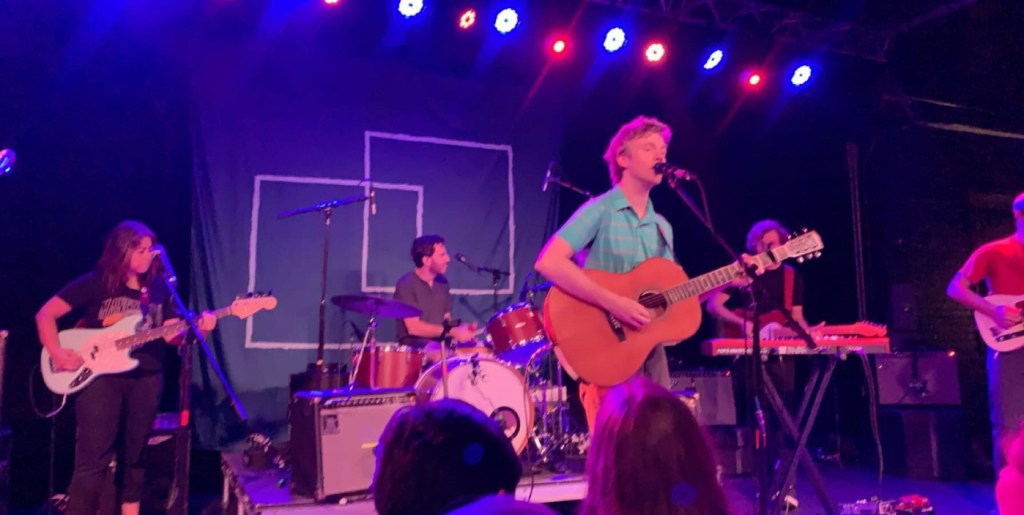
Pinegrove is the kind of band you would drive four hours to go see on a Tuesday night. And this week I did just that.
An indie rock band hailing from Montclair, New Jersey, the last stop of Pinegrove’s latest tour was at The Waiting Room in Omaha, Nebraska. Their openers that night included Common Holly of Montréal and Stephen Steinbrink of Oakland, CA.
Front man Evan Stephens Hall once said in an online forum that his goal for Pinegrove’s music is to “promote introspective partying.” This show met the expectation.
Any time I’ve seen Pinegrove perform, the audience maintains a certain level of fascinated electricity despite the often-mellow music. You look around to see a group of young people nodding their heads in solidarity, collectively chanting lyrics that mean something spectacular to each of them.
The designated fan-favorite song is “Old Friends,” a song loosely about loss and being lost. As Hall tuned his acoustic guitar, preparing the song’s opening chords, the crowd hollered. They knew what was coming. Before the band had reached the chorus, Hall abruptly stopped playing with a bashful grin on this thin face. He had forgotten the words to their most iconic track.
“I’m so sorry, guys,” he said, “it’s just… we’ve played this song so many times, sometimes I just zone out.” He asked if we would mind if they started over, and of course we didn’t.
Together then a group of strangers found solace in song. Maybe this happens at every other concert, but after shows like this one, I’m not so sure.
My personal favorite track by Pinegrove is “Cadmium,” a song with lyrics that articulate the exact effect the band seems to have on its listenership:
“I hold you, put your neck out / Tell me the ways you wish you were”
Pinegrove’s music notably encourages reflection: on yourself and on the ways to love those around you. You are a subject of constant reconstruction. The lyrics written by Hall aren’t afraid to admit personal faults, all the while ensuring intention to do better.
Their closing song of the evening, “Aphasia,” reinforced Pinegrove’s values before turning us away. In an interview with Pitchfork, Hall elaborated on the song, named for a neurological disorder that affects one’s ability to communicate:
“It’s a fear of mine that I won’t be able to express myself well enough, or that I’ll be somehow trapped inside myself. Maybe a lot of people feel that way.”
Based on the vivid unity of the crowd, it’s clear Hall has been understood.

 HAVOC MUSIC